Welcome!

I am Fajar Nur Azizi Graphics Designer

View Work Hire Me!

About Me

Web Design
Branding
Development
Who am i

John Doe.

Professional Web Designer

Nulla metus metus ullamcorper vel tincidunt sed euismod nibh Quisque volutpat condimentum velit class aptent taciti sociosqu ad litora.

Nulla metus metus ullamcorper vel tincidunt sed euismod nibh Quisque volutpat condimentum velit class aptent taciti sociosqu ad litora torquent metus metus ullamcorper vel tincidunt sed class aptent taciti sociosqu ad litora .

Services

Web Design

Nulla metus metus ullamcorper vel tincidunt sed euismod nibh Quisque volutpat

Development

Nulla metus metus ullamcorper vel tincidunt sed euismod nibh Quisque volutpat

Branding

Nulla metus metus ullamcorper vel tincidunt sed euismod nibh Quisque volutpat

Marketing

Nulla metus metus ullamcorper vel tincidunt sed euismod nibh Quisque volutpat

Our Blog

Tampilkan postingan dengan label Artikel Bahasa Inggris. Tampilkan semua postingan

CULVERT ( Gorong-Gorong )

Culvert is a structure that allows water to flow under a road, railroad, trail, or similar obstruction. Typically embedded so as to be surrounded by soil, a culvert may be made from a pipe, reinforced concrete or other material. A structure that carries water above land is known as an aqueduct.
Culverts may be used to form a bridge-like structure to carry traffic. Culverts come in many sizes and shapes including round, elliptical, flat-bottomed, pear-shaped, and box-like constructions
Culverts have three distinct uses. One is to control and direct drainage of accumulated storm water runoff from crowned roads and side ditches. Another use is to provide stream crossings for all three road types. The third and least recognized use is to allow for natural movement of surface water on wet sites where fill roads would otherwise adversely affect natural flow and alter the hydrology of the area. This section covers the first and third uses. Another section will cover water crossings.
Where possible, install culverts in natural draws on all roads. If this is not convenient or if the culverts would be too far apart, follow the broad-based dip spacing guidelines in Table bellow :


Table 1: Recommended spacing for water turnouts, culverts or broad-based dips on wet soils.
Road Grade
Spacing Between Dips
2
300
3
235
4
200
5
180

Culverts - all other structures.

  • Even though the costs of culverts are less than those of bridges, there are many times more culverts than bridges, and the total investment of public funds for culverts constitutes a substantial share of highway dollars.
  • Culverts are usually designed to operate with the inlet submerged if conditions permit. This allows for a hydraulic advantage by increased discharge capacity. Bridges are usually designed for non-submergence during the design flood event, and often incorporate some freeboard.
  • Culvert maintenance requirements include efforts to assure clear and open conduits, protection against corrosion and abrasion, repair and protection against local and general scour, and structural distress repair. 


Besides that, culverts is also has some type :
     1.  Pipe Arch Single or Multiple
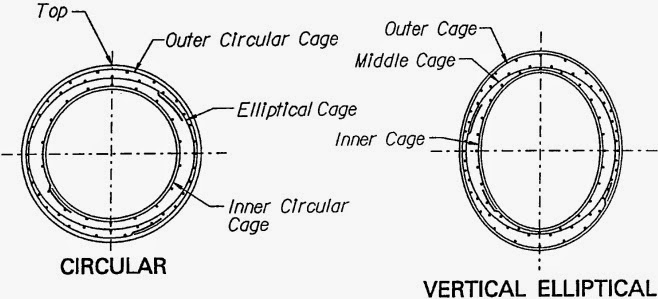
Pipe-arch culverts provide low clearance, openings suitable for large waterways, and are more aesthetic. They may also provide a greater hydraulic advantage to fishes at low flows and require less road fill.
2.    Box Culvert Single or Multiple
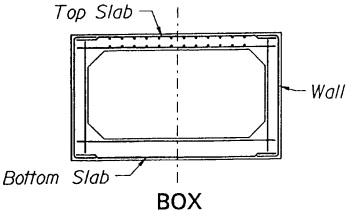
Box culverts are used to transmit water during brief runoff periods. Theses are usually used by wildlife because they remain dry most of the year. They can have an artificial floor such as concrete. Box culverts generally provide more room for wildlife passage than large pipe culverts. Box culvertsare usually made up of Reinforced Concrete (RCC)

       3.  Arch Culvert

A pipe arch culvert is a round culvert reshaped to allow a lower profile while maintaining flow characteristics. It is good for installations with shallow cover.

Material Of Culverts

There is some material that used to build Culverts :

ü  concrete (reinforced and non-reinforced)
ü  steel (smooth and corrugted)
ü  corrugated aluminum
ü  vitrified clay
ü  plastic
ü  bituminous fiber
ü  cast iron
ü  wood
ü  stainless steel
Two or more materials may be combined to form composite structures. For example, open-bottom corrugated steel structures are often built on concrete footings. Plastic culvert liners are also inserted into failing concrete or steel structures in order to repair the structure without excavating and closing the road. To prevent the older structure from collapsing, the space between it and the plastic liner is usually filled with grout.

Culvert End Treatments

end structures are attached to end of culvert barrel to reduce erosion, inhibit seepage, retain the fill, and improve hydraulic characteristics.
Possible Choices:
·         Projecting
·         Mitered
·         Flared-end Section
·         Headwalls and Wingwalls


FORKLIFT

Sometimes called a forklift truck, the forklift is a powerful industrial truck that is used to lift and transport material by steel forks that are inserted under the load. Forklifts are commonly used to move loads and equipment that is stored on pallets. The forklift was developed in 1920, and has since become a valuable piece of equipment in many manufacturing and warehousing operations.

Types of Forklifts
The most common type of design with forklifts is the counter balance. Other types of designs include the reach truck and side loader, both of which are used in environments where the space is at a minimum.

Control and capability
Forklifts are available in many types and different load capacities. In the average warehouse setting,most forklifts have load capacities of around five tons. Along with the control to raise and lower the forks, you can also tilt the mast to compensate for the tendency of the load to angle the blades towards the ground and risk slipping it off the forks. The tilt will also provide a limited ability to operate on ground that isn’t level.There are some variations that allow you to move the forks and backrest laterally, which allows easier placement of a load. In addition to this, there are some machines that offer hydraulic control to move the forks together or further apart, which removes the need for you to get out of the cab to manually adjust for a different size load.
Another forklift variation that is sometimes used in manufacturing facilities, will utilize forklifts with a clamp attachment that you can open and close around a load, instead of having to use forks. Products such as boxes, cartons, etc., can be moved with the clamp attachment.

Safety
Forklifts are rated for loads at a specified maximum weight and a specified forward type center of gravity. All of this information is located on a nameplate that is provided by the manufacturer and the loads cannot exceed these specifications. One of the most important aspects of operating a forklift is the rear wheel steering. Even though this helps to increase maneuverability in tight cornering situations, it differs from the traditional experience of a driver with other wheeled vehicles as there is no caster action. Another critical aspect of the forklift is the instability. Both the forklift and the load must be considered a unit, with a varying center of gravity with every movement of the load.You must never negotiate a turn with a forklift at full speed with a raised load, as this can easily tip the forklift over.

FRONT LOADER

Also known as a front end loader, bucket loader, scoop loader, or shovel, the front loader is a type of tractor that is normally wheeled and uses a wide square tilting bucket on the end of movable arms to lift and move material around.The loader assembly may be a removable attachment or permanently mounted on the vehicle. Often times, the bucket can be replaced with other devices or tools, such as forks or a hydraulically operated bucket.
Larger style front loaders, such as the Caterpillar 950G or the Volvo L120E, normally have only a front bucket and are known as front loaders, where the small front loaders are often times equipped with a small backhoe as well and called backhoe loaders or loader backhoes.Loaders are primarily used for loading materials into trucks, laying pipe, clearing rubble, and also digging. Loaders aren’t the most efficient machines for digging, as they can’t dig very deep below the level of their wheels, like the backhoe can.
The deep bucket on the front loader can normally store around 3 – 6 cubic meters of dirt, as the bucket capacity of the loader is much bigger than the bucket capacity of a backhoe loader. Loaders aren’t classified as excavating machinery, as their primary purpose is other than moving dirt.In construction areas, mainly when fixing roads in the middle of the city, front loaders are used to transport building materials such as pipe, bricks, metal bars, and digging tools. Front loaders are also very useful for snow removal as well, as you can use their bucket or as a snow plow. They can clear snow from the streets and highways, even parking lots.They will sometimes load the snow into dump trucks which will then haul it away.
Unlike the bulldozer, most loaders are wheeled and not tracked. The wheels will provide better mobility and speed and won’t damage paved roads near as much as tracks, although this will come at the cost of reduced traction. Unlike backhoes or tractors fitted with a steel bucket, large loaders don’t use automotive steering mechanisms, as they instead steer by a hydraulically actuated pivot point set exactly between the front and rear axles.This is known as articulated steering and will allow the front axle to be solid, therefore allowing it to carry a heavier weight.
Articulated steering will also give a reduced turn in radius for a given wheelbase. With the
front wheels and attachment rotating on the same axis, the operator is able to steer his load in an arc after positioning the machine, which can come in quite handy. The problem is that when the machine is twisted to one side and a heavy load is lifted high in the air, it has a bigger risk of turning over.

Contact Us

Phone :

+20 010 2517 8918

Address :

3rd Avenue, Upper East Side,
San Francisco

Email :

email_support@youradress.com